
In YouTube Shorts vs. long videos, each format has its own job. Shorts put a new channel in front of strangers fast. Long videos keep those viewers and earn most of the ad money. So, plan the ratio first.
AIR Media-Tech, the group ScaleLab is part of, pulled YouTube Analytics data from 274 channels that post both formats. In almost every niche, Shorts paid 3–14% of what long videos earned per view. That means 11,000 to 34,000 Shorts views to match the revenue of 1,000 long-form views. For most of those channels, Shorts brought 1–35% of views and less than 2% of revenue.
The ratio is where we part ways with most guides. They suggest three to five Shorts for every long video. In the same AIR study, channels did best with roughly one Short for every two or three long uploads, and channels that pivoted hard to Shorts did worse.
Key takeaways
- Shorts help a new channel get seen, but their watch time doesn't count toward monetization. A channel joins the YouTube Partner Program with 1,000 subscribers and either 4,000 watch hours in 12 months, where Shorts Feed views don't count, or 10 million Shorts views in 90 days. YouTube has announced that from February 1, 2027, new channels will need 8,000 watch hours in 365 days or 20 million Shorts views in 90 days.
- Long videos of 8 minutes or more can carry mid-roll ads, so one view can show several ads. Shorts earn a share of a pooled ad revenue instead.
- YouTube took a record 15.8% of all US TV viewing in August 2026, ahead of Disney at 9.3% and Netflix at 7.7%, according to Nielsen.
- Livestreams pay off when they're regular. In AIR Media-Tech's study of 404 channels in 2025, channels streaming 8 or more times a month earned a median 50.2% of their ad revenue from live, against 4.4% at one stream a month.
- How a video is delivered can matter as much as its length. A music channel with 340K subscribers that AIR Media-Tech works with switched every upload to 4K in May 2025 and earned 52% more the next quarter.
YouTube Shorts vs. Long Videos: Which Is Better for Each Goal
Which format is better depends on what your channel needs right now. A new channel needs to be found. A monetized one needs watch time on videos that carry ads. Here's how the three formats compare on the things that decide it.
Sources: YouTube Help — Understand three-minute YouTube Shorts; YouTube Help — YouTube Partner Program overview & eligibility; YouTube Help — Manage mid-roll ad breaks in long videos; YouTube Help — Changes to the YouTube Partner Program; AIR Media-Tech research of 274 channels and of 404 channels in 2025, linked in the text. Checked November 2026.
What Shorts Do for a New Channel
Shorts get a channel in front of people who have never heard of it. The Shorts feed shows videos to viewers who don’t follow you, which is why a new channel often gets its first real views there.
Since October 15, 2024, any vertical or square video up to three minutes long counts as a Short. That’s enough room for one full tip or one scene from a longer video. So we’d cut most Shorts from your long uploads instead of filming them separately.

If you’re still choosing where to post short videos, we compared YouTube Shorts and TikTok and Shorts and Instagram Reels side by side. For what makes a Short travel, here are 41 tips to make YouTube Shorts go viral.
The Shorts Trap: Subscribers Who Never Watch Your Long Videos
A Short that takes off can bring in thousands of subscribers who never open a long video. They followed you for a 30-second clip, and a 20-minute upload isn’t what they came for.
AIR Media-Tech tracked 18,000 English-language channels from March 2025 to March 2026. In fitness, food, business, and education, channels that mixed in Shorts had more subscribers than long-only channels. In gaming, science, and entertainment at scale, long-only channels led. Once Shorts passed 55% of uploads, long-form audiences started to thin out in every niche. The study shows correlation, not cause, but the pattern held across all 11 niches.
So each Short has one job, which is to send the right viewers to one long video. Here’s how we set that up.
- Cut the Short from the long video it points to, so the topic carries over.
- In YouTube Studio, open the Short and pick that long video under Related video. Viewers see it as a clickable link under your channel handle. You need advanced feature access for this.
- Show the result in the Short and keep the how-to for the long video.
- Say where the rest is in the last few seconds of the Short.
After a month, open the Viewers across formats report in YouTube Studio Analytics. It shows how many of your viewers watch both Shorts and long videos. If that overlap stays small, your Shorts are bringing in a different audience from the one your long videos serve.
Your Shorts get views, but your long videos stall?
Thousands of Shorts views with no lift on long videos means the two formats reach different people. We'll review your recent uploads and plan a mix that moves viewers over.
YouTube Shorts RPM vs. Long-Form: 11,000 Shorts Views for 1,000 Long Ones
Shorts and long videos earn in two different ways. Long videos of 8 minutes or more can carry mid-roll ads, so one view can show several ads. Shorts earn from a Creator Pool that YouTube splits by each creator’s share of engaged views, and you keep 45% of your allocation. From February 1, 2027, YouTube has announced that channels will earn from the Creator Pool only in months when they have 10 million qualified Shorts views over the last 90 days. Missing that bar doesn’t remove a channel from the YouTube Partner Program or touch its long-form earnings.
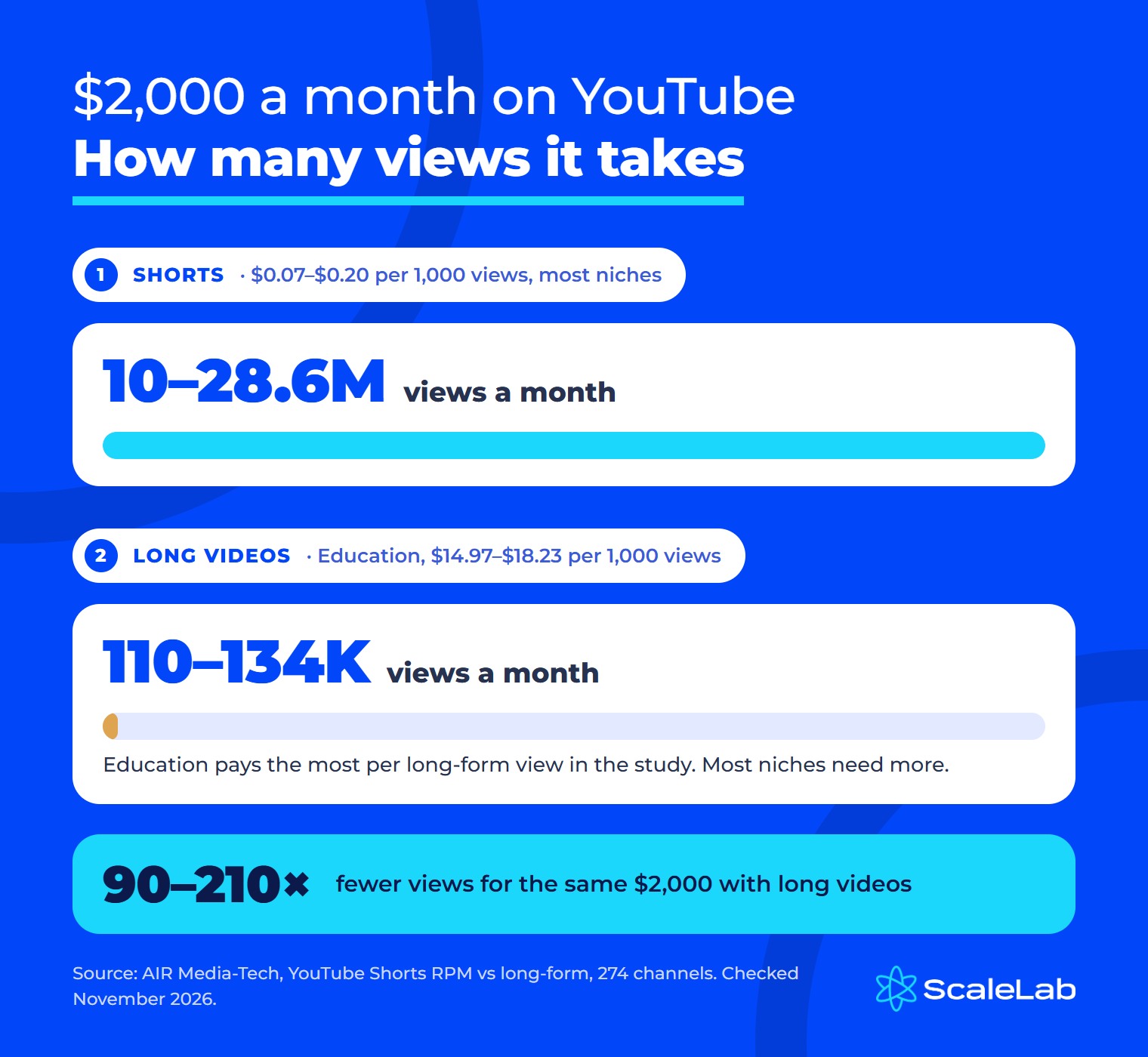
That’s where the gap in AIR Media-Tech’s numbers from 274 channels comes from. Shorts paid about $0.07–$0.20 per 1,000 views in most niches, and around $0.33 with a mostly US audience. Education long videos earned $14.97–$18.23 per 1,000 views. Music is the one exception. Content ID lets rights holders earn from Shorts, so music Shorts reached 41–60% of long-form RPM. For Shorts pay by niche and country, see how much YouTube pays for Shorts.
Adding Shorts can also pull down a channel’s overall RPM. In Entertainment, the same channels earned less in the months they posted Shorts.
Months without Shorts
$4.58
RPM of the same Entertainment channels
Months with Shorts
$1.84
60% lower, as low-paying Shorts views joined the mix
Source: AIR Media-Tech research of 274 channels, linked above. Correlation, not cause. Checked November 2026.
Gaming barely moved, at $3.42 against $3.29. So after you start posting Shorts, compare your RPM in YouTube Studio with the month before. If it drops, the Shorts views are diluting it, and your long videos aren’t earning less per view. At those rates, $2,000 a month takes about 10 million to 28.6 million Shorts views, or about 110,000 to 134,000 long-form views in Education.
Long Videos on the TV Screen: Why CTV Watch Time Matters
A growing share of YouTube is watched on a TV. Connected TV, or CTV, means a smart TV, streaming stick, or game console that plays YouTube over the internet. In August 2026, YouTube took a record 15.8% of all US TV viewing, Nielsen reports, ahead of Disney at 9.3% and Netflix at 7.7%.
That screen suits long videos. YouTube says people tend to watch in longer sessions on TV than on other devices, and it counted over a billion hours of YouTube watched on TVs every day in late 2024. A horizontal video fills the screen, while a Short plays in a narrow vertical frame.
Here’s what YouTube recommends for TV viewers.
- Check your TV watch time in YouTube Analytics. In Advanced Mode, filter by device type.
- Upload in 4K where you can.
- Make thumbnails readable from across the room, at 1280×720 or higher.
- Build episodes and group them into playlists, so autoplay keeps people watching.
One Change, +52%: A Music Channel That Switched to 4K
A music channel with 340K subscribers that AIR Media-Tech works with posted its first 4K video on May 12, 2025, then moved every upload to 4K. Revenue rose 52% the next quarter. The content stayed the same. The channel changed only the picture quality, which TV viewers notice first.
Livestreams: The Third Format Most Channels Skip
Most guides tell a new channel to skip streams, and with no audience yet, that’s fair. In AIR Media-Tech’s study of 404 channels in 2025, the median stream drew 45 views.
Streams start to pay once people come back for you. Live RPM beat long-form RPM in about half the niches in that study. Channels streaming 8 or more times a month earned $5.67 per 1,000 live views, against $4.59 for their regular videos. For subscribers gained per hour of your time, 2–3 promoted streams a month, each under 2 hours, worked best.
One catch is that regular videos often got fewer views in streaming months. The study puts most of that down to seasonality and splitting your upload effort. For what to stream and how to keep the chat going, see our 15 live stream ideas and 12 tips for interacting with viewers during a stream.
24/7 Streams With No One on Camera
The biggest live numbers in that study came from round-the-clock broadcasts built from videos a channel had already published. There’s no camera and nobody in the chair. Two channels AIR Media-Tech works with show what that can do.
- Lesnoy, a DIY channel with 393K subscribers, started a 24/7 stream in March 2025. In March and April, it drew 1.15 million views and 2,000+ new subscribers, with an average view of 13:33 against 8:33 on regular videos.
- DONA English, a kids’ channel with 5.2 million subscribers, went live with four simultaneous streams of pre-recorded videos. By the second month, streaming brought in 60% of its revenue.
If your library has hours of videos people rewatch, like music, kids’ content, or background videos, a 24/7 stream is the cheapest format on this list to test.
How Many Shorts per Long Video: A Weekly Mix by Channel Stage
Put the numbers above together, and the mix changes as the channel grows. In AIR Media-Tech’s research of 18,000 channels, channels did best when Shorts made up 25–40% of uploads, and long-form audiences thinned out past 55%.
Here’s the mix we’d start with.
Sources: AIR Media-Tech research of 18,000 channels and of 404 channels in 2025, linked in the text. Checked November 2026.
Your niche moves these numbers. In the same 18,000-channel data, gaming and science channels did better with long videos only, while fitness, food, business, and education gained from the mix. So treat the table as a starting point, and check your RPM and the Viewers across formats report after a couple of months.
Not sure which mix fits your channel?
We'll go through your Shorts, long videos, and streams in YouTube Analytics and send you a mix plan for your niche and stage.
ScaleLab is a force multiplier for creators, designed to help them scale their digital presence. We are a US-based company and part of AIR Media-Tech, a leading global creator ecosystem. With a suite of 30+ tools and a team of experts, we help creators grow their income, increase engagement, and protect their content through growth strategies, AI-powered content management, global localization, financial flexibility, brand-deal enablement, distribution, live streaming, and channel safety services. ScaleLab is a YouTube Certified Partner.